In honor of World Drowning Prevention Day, July 25
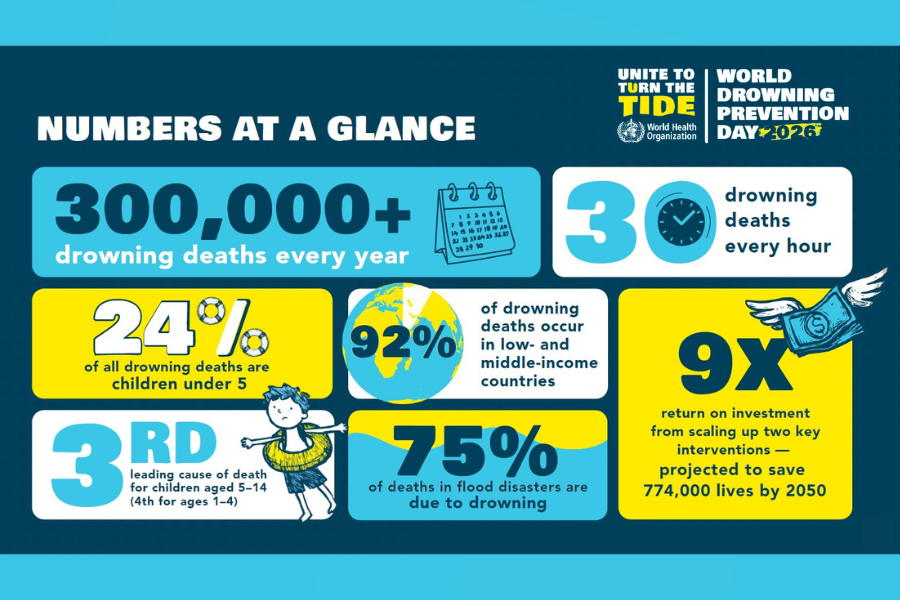
Every year, more than 300,000 people drown, roughly 30 people every hour, somewhere in the world. It is one of the leading causes of accidental death globally, and it disproportionately claims children. Most of these deaths are preventable. That single fact is why the World Health Organization(WHO) and its partners keep returning to the same message every July 25th: drowning prevention isn’t just a public health statistic to reduce. It’s infrastructure for a safer, more resilient world.
Bigger Than a Health Issue
It’s tempting to file drowning under “accidents” and move on. But drowning prevention is central to child survival, climate resilience, safer livelihoods, education, transport safety, and economic productivity. When a community invests in water safety, the return isn’t limited to fewer emergency room visits. It shows up in classrooms, in flood-prone villages, and on fishing boats. Prevention ripples outward in ways that are easy to miss until you start looking for them.
Here’s what that ripple actually looks like.
Child survival. Drowning is one of the top killers of children worldwide, particularly kids between 5 and 14. Basic swim and water-safety education, active supervision, and simple barriers like pool fencing address a threat that competes with and in many regions exceeds the risks families spend far more energy worrying about.
Climate resilience. As flooding events grow more frequent and severe, drowning risk rises with them. Flood early-warning systems and water-safety education are climate adaptation tools as much as they are public health tools. A community that knows how to respond to rising water is a community better equipped for these environmental changes.
Safer livelihoods. For millions of people who fish, ferry, or transport goods across water for a living, drowning is an occupational hazard. Life jackets, boat safety regulation, and training don’t just save individual lives, they protect the economic backbone of entire coastal and river communities.
Transport safety. Regulated ferries, ships, and boats with enforced safety standards prevent the kind of large-scale tragedies that make headlines as well as the smaller, daily risks that don’t.
Economic productivity. A drowning death is not just a personal tragedy; it’s a loss borne by families, employers, and local economies. Investing in prevention is, as the WHO puts it, one of the smartest investments a country can make.
We Already Know What Works
This isn’t a mystery waiting to be solved. Swim and water safety education, supervised childcare near water, life jackets, CPR training, pool fencing, regulated boats, and flood early-warning systems all save lives — reliably and at relatively low cost. Over 85% of drownings can be prevented using measures that already exist and are already proven. The Global Strategy for Drowning Prevention gives governments, communities, and organizations a shared roadmap for putting these measures to work. What’s missing isn’t knowledge. It’s scale.
What This Means for Swim Schools
For those of us in the swim lesson world, this is the day that puts our daily work in its proper context. A child learning to float, a parent learning what active supervision actually looks like, an instructor teaching survival skills, these aren’t small, local acts. They are part of a global strategy that touches child survival, climate adaptation, education continuity, and economic stability all at once.
Swim schools sit at the front line of one of the most cost-effective public health interventions in the world. That’s worth remembering not just on July 25th, but every time a family walks through the door for a first lesson.
Get Involved
This year’s global theme, “Unite to Turn the Tide,” is a call for exactly that kind of collective effort, governments, communities, and organizations working together instead of in isolation. You can mark World Drowning Prevention Day by:
- Enrolling a child or adult in swim lessons
- Talking to your community about active supervision and water safety basics
- Sharing your own story or lesson learned using #WorldDrowningPreventionDay and #DrowningPrevention
- Supporting local organizations working on water safety education and access
Drowning is preventable. We know the risks, and we have the solutions. What we need now is scale and every swim lesson, every safety conversation, and every policy conversation gets us closer.